11+ Reading Speed & Comprehension
Why both matter when preparing for the 11+
The 11+ is not simply a test of how quickly a child can read. It requires children to read accurately, process information efficiently and understand increasingly challenging texts.
For many children, reading speed becomes particularly important during 11+ preparation because they may need to read a passage, understand it, identify key information and answer a series of questions — all within a limited amount of time.
The goal is therefore not simply to make your child read faster.
The goal is to help them become a fluent, confident reader who can read at an efficient pace without losing comprehension.
Typical Reading Speeds
These figures provide a useful general guide to reading fluency:
8 years: 80–110 WPM
9 years: 90–120 WPM
10 years:100–130 WPM
11 years:110–140 WPM
WPM = words per minute.
These are broad guidelines rather than fixed targets. Children develop at different rates, and reading speed will vary according to the difficulty of the text.
For 11+ preparation, it is also important to remember that test passages are often more demanding than everyday children's reading. Vocabulary, sentence structure, inference and the amount of information presented can all increase the cognitive load.

Why Does Reading Speed Matter for the 11+?
Time is an important part of many 11+ examinations.
A child may need to:
Read a passage.
Understand what is happening.
Identify important information.
Work out implied or inferred meaning.
Interpret unfamiliar vocabulary.
Refer back to the passage.
Answer questions accurately.
Move on within the allocated time.
If a child reads extremely slowly, they may spend too much of their available time simply processing the passage.
Developing reading fluency can therefore make a significant difference.
When familiar words and common sentence structures are processed automatically, the child has more mental capacity available for the harder work of understanding, reasoning and answering questions.
But Faster Does NOT Automatically Mean Better
This is one of the most important messages for parents.
A child who races through a passage but misses important details may perform worse than a child who reads slightly more slowly but understands the text thoroughly.
For example:
Child A
Reads 140 WPM
✓ Reads quickly
✗ Misses details
✗ Misunderstands questions
✗ Makes careless inference errors
Child B
Reads 115 WPM
✓ Reads accurately
✓ Understands the passage
✓ Identifies important information
✓ Answers questions carefully
For 11+ preparation, we want to help children move towards efficient reading, rather than simply chasing a higher WPM number.

The 11+ Reading Sweet Spot
Think of successful reading as a balance:
ACCURACY - FLUENCY - EFFICIENT SPEED - COMPREHENSION- ANSWERING ACCURATELY
If increasing speed causes comprehension to drop, the child has gone too fast. If a child understands everything but takes so long to read that they struggle to finish timed sections, fluency and efficiency may need further development. The aim is to find the pace at which the child can read efficiently while continuing to understand and think about the text.
What Does a Strong 11+ Reader Look Like?
A strong reader should increasingly be able to:
read unfamiliar texts confidently;
recognise common words automatically;
read in meaningful phrases rather than word-by-word;
use punctuation to support meaning;
cope with more complex sentence structures;
understand unfamiliar vocabulary from context;
identify the main idea;
locate specific information quickly;
make inferences;
recognise what a question is asking;
return to the text to check an answer;
distinguish important information from less important detail.
These skills are often more valuable than simply achieving a particular WPM score.
Reading Speed Should Be Developed Alongside Comprehension
During 11+ preparation, parents can encourage children to practise both skills.
Try a short timed reading activity
Ask your child to read a suitable passage for one minute. Record approximately how many words they read. Then ask a few questions about the passage.
The important question is not: "How many words did you read?"
It is: "How much of what you read did you understand?"
Over time, you are looking for both: Reading fluency and Comprehension without one coming at the expense of the other.
Parents sometimes assume that their child should simply read increasingly difficult novels.
Independent reading is extremely valuable, but 11+ preparation should also expose children to a range of text types, such as:
fiction;
non-fiction;
biographies;
historical writing;
articles;
descriptive passages;
informational texts;
unfamiliar subjects.
This helps children become comfortable with different vocabulary, writing styles and sentence structures.
The Parent's Role
Parents do not need to turn reading at home into another lesson. Some of the most useful things you can do are:
Read regularly. Short, consistent practice is more useful than occasional intensive sessions.
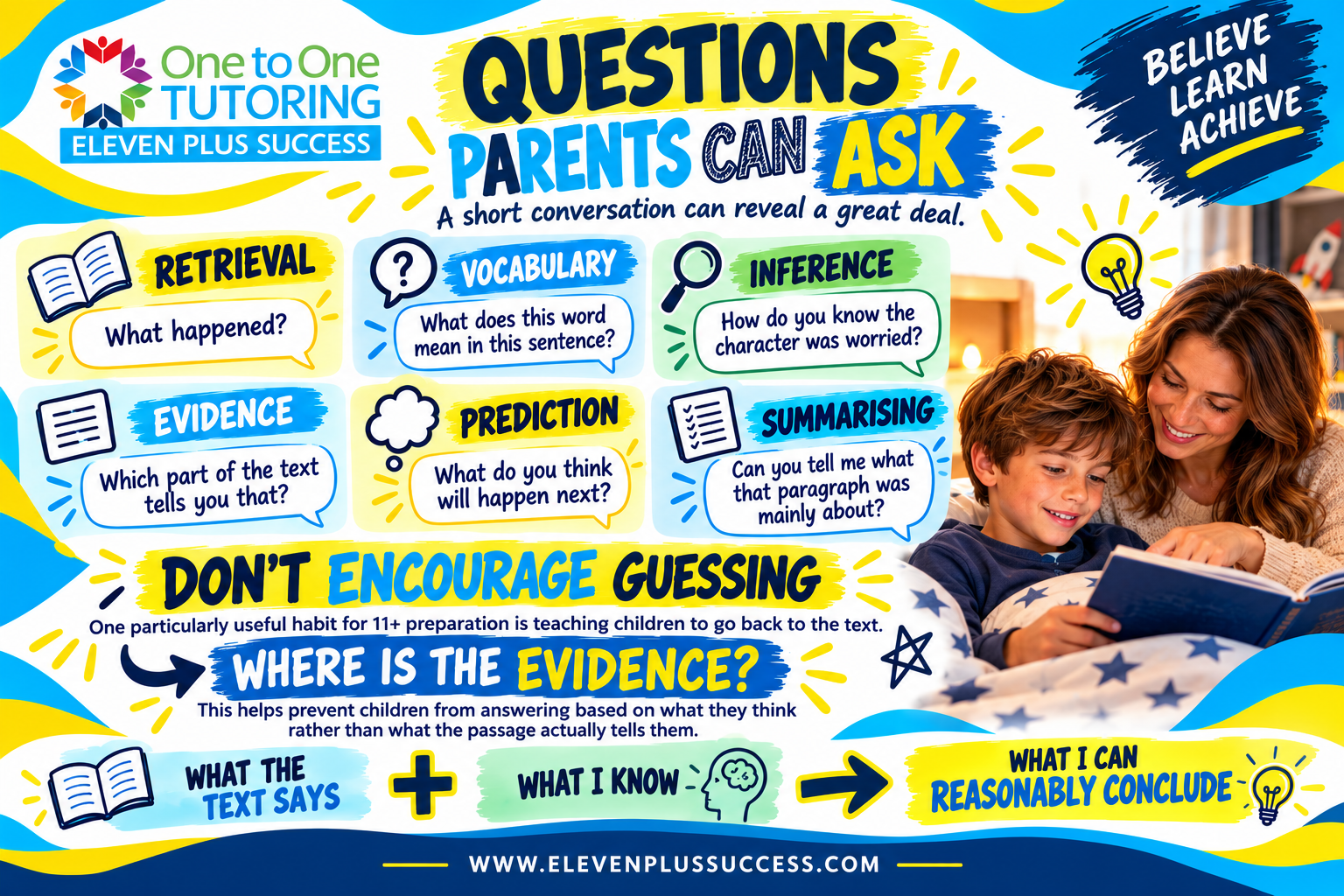
Talk about what your child reads. Discuss characters, ideas, vocabulary and information.
Encourage accuracy. Don't praise speed if the child has misunderstood the passage.
Encourage fluency. Listen for smooth reading rather than word-by-word decoding.
Build vocabulary. Discuss interesting or unfamiliar words.
Ask "How do you know?" Encourage children to support answers with evidence.
Gradually introduce timed activities. As the 11+ approaches, children need opportunities to practise working efficiently under time pressure.
The Key Message for Parents
For 11+ preparation, reading speed matters — but comprehension matters more. A child who can read quickly but does not understand the passage will struggle.
A child who understands everything but reads so slowly that they cannot complete the paper may also struggle. The objective is to develop a reader who can:
Read accurately. Read fluently. Read efficiently. Understand deeply. Answer accurately
We are not trying to create children who simply read faster. We are developing children who can process challenging text efficiently while retaining meaning — an essential skill for the 11+ and for secondary school.
Below you can take a reading assessment. Once completed please give to Nic or one of the team. Chris will then contact you with some feedback about next steps.
Reading Difficult Books Isn't the Only Answer