Year 3 Foundations
Confidence and Growth: The Foundation for Your Child’s Success
Why start in Year 3?
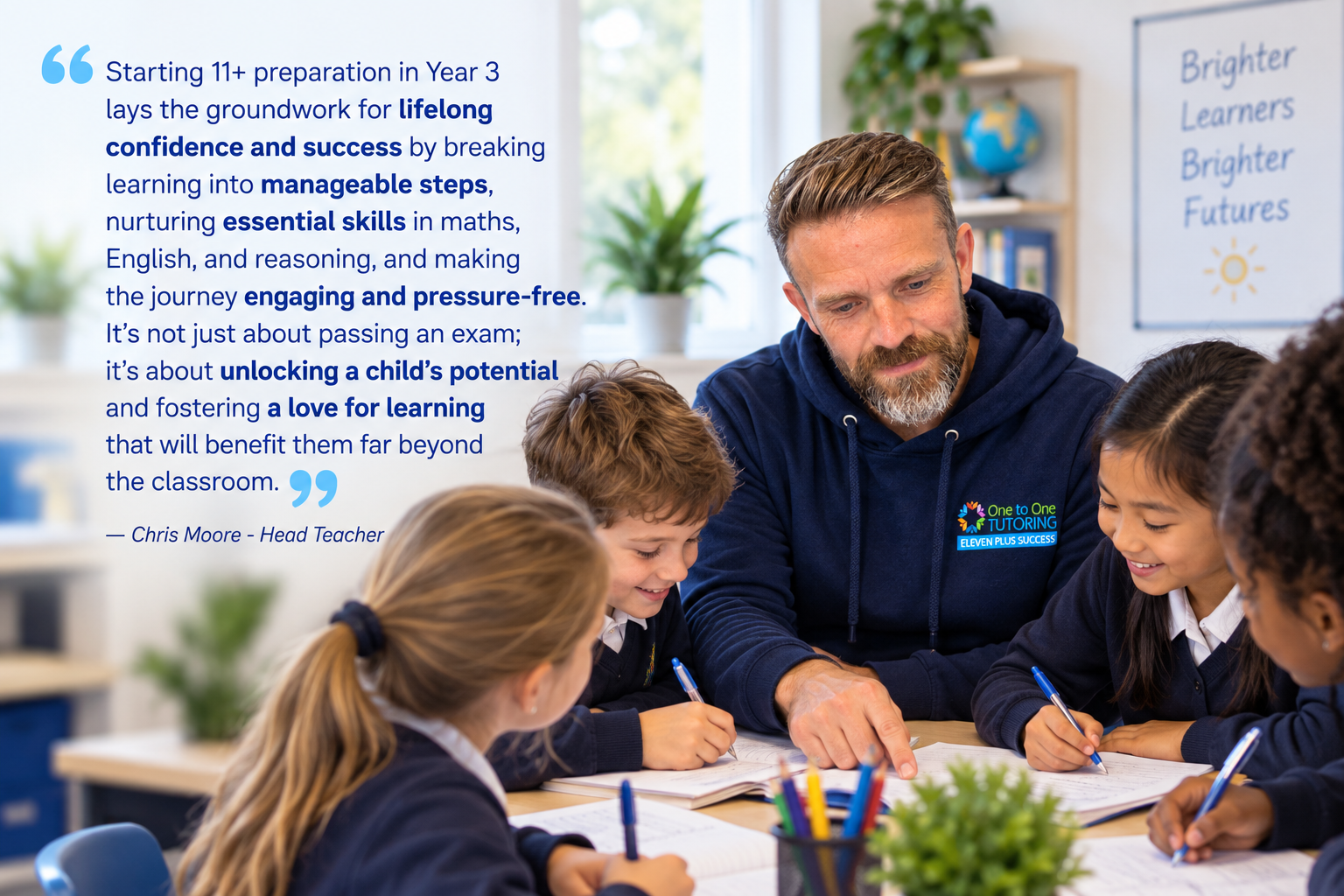
Starting tutoring in Year 3 for the 11+ exam gives children the invaluable opportunity to build a strong foundation in maths, English, and vocabulary at a manageable pace, ensuring they grasp core concepts thoroughly. This early start not only boosts their confidence and academic potential for the test but also sets them up for long-term success in school by developing essential skills that underpin all areas of learning.

One Hour a Week, Making Every Minute Count
Our one-hour weekly lessons focus primarily on English and maths, with every session tailored to your child’s individual needs, ability and pace. We break learning into manageable steps, helping children develop their skills while building confidence and enjoying the learning process.
We carefully balance the session between the two subjects, while allowing flexibility depending on the child's individual needs. If a child requires additional support with a particular area of maths or English, we can adjust the lesson accordingly. Equally, children who are progressing confidently can be given additional challenges to extend their thinking.
The aim is to create a manageable and sustainable approach to learning. At Year 3, we are building strong foundations rather than putting children under unnecessary pressure to complete large amounts of 11+ material.
Over time, these regular weekly sessions help children develop stronger core knowledge, greater confidence and increasingly independent learning habits.
Building Strong Mathematical Foundations
In maths, our focus is on developing a secure understanding of the core skills that children will rely on as they progress through school and eventually tackle more challenging 11+ questions.
We work on areas such as:
Mental arithmetic and calculation strategies
Times tables and number facts
Place value and number sense
Addition, subtraction, multiplication and division
Fractions and mathematical relationships
Problem-solving and reasoning
Working accurately and efficiently
Explaining mathematical thinking
We believe that maths should be more than simply completing a worksheet. Wherever appropriate, we use games, challenges, puzzles and interactive activities to help children practise important skills in an enjoyable and memorable way.
For example, times tables can be developed through quick-fire games and challenges, while problem-solving activities encourage children to think carefully about how they approach a question rather than simply searching for an answer.
This combination of practice, discussion and problem-solving helps children develop fluency, accuracy and confidence, while encouraging them to see maths as something they can enjoy and succeed in.

Year 3 11+ Preparation: Building Strong Foundations
At One to One Tutoring, we understand that Year 3 is an important stage in a child’s educational journey. While the 11+ exam may still feel some way off, these early years provide a valuable opportunity to develop the knowledge, skills, confidence and learning habits that will support children as they progress towards the exam — and, importantly, throughout their wider education.
Our Year 3 lessons are carefully designed to make learning engaging, manageable and purposeful. We recognise that every child learns differently, so our one-to-one approach allows us to adapt lessons to suit each child’s individual strengths, areas for development, pace and interests.
Rather than overwhelming children with large amounts of work, we break each lesson into small, achievable steps. This allows children to concentrate on one skill at a time, experience regular success and gradually develop greater independence and confidence.

Introducing Verbal and Non-Verbal Reasoning
For children who are ready to take their learning further, we can begin introducing Verbal Reasoning and Non-Verbal Reasoning in a gentle and age-appropriate way.
At Year 3, our aim is not to put children under pressure or turn every lesson into exam preparation. Instead, we introduce reasoning through puzzles, patterns, word games, visual challenges and interactive activities that encourage children to think in different ways.
Verbal Reasoning activities can help children develop skills such as:
Recognising relationships between words
Identifying patterns
Developing vocabulary
Making connections
Thinking logically
Following instructions carefully
Non-Verbal Reasoning activities introduce children to visual patterns, shapes, sequences and relationships, helping them develop their ability to observe, compare and reason.
By introducing these concepts gradually, children can become familiar with different types of thinking without feeling that they are being asked to prepare for an exam before they are ready.

Developing Reading, Comprehension and English Skills
Our English sessions focus on developing children into confident, thoughtful and independent readers.
Rather than simply asking children to read a passage and answer questions, we encourage them to talk about what they have read. Through discussion, children learn to identify important information, make connections, explain their ideas and support their answers with evidence from the text.
We explore areas such as:
Reading comprehension
Vocabulary development
Inference and deduction
Understanding characters and their motivations
Themes and ideas within a text
Finding and interpreting information
Explaining answers clearly
Multiple-choice questions
Open-ended comprehension questions
Developing vocabulary is particularly important at this stage. We encourage children to notice unfamiliar words, consider their meaning from context and explore alternative words and phrases. This helps strengthen both their reading comprehension and their ability to express themselves accurately.
As children become more confident, we gradually introduce different question styles and encourage them to think beyond the obvious answer. This develops the deeper reading and analytical skills that will become increasingly important as they move towards the 11+.
Developing Confidence and Independent Learning
Academic progress is only one part of successful 11+ preparation. We also want children to develop the confidence and learning habits that will help them as they progress through school.
Our lessons encourage children to:
Have a go at unfamiliar questions
Explain their thinking
Ask questions when they are unsure
Learn from mistakes
Work carefully and independently
Manage their time appropriately
Persevere when something is challenging
Take pride in their progress
We celebrate progress at every level, helping children recognise what they can do while identifying the next small step they can work towards.
Preparing for the Future Without the Pressure
Our approach to Year 3 is about building foundations rather than rushing ahead.
We want children to develop a strong understanding of the fundamentals before moving on to more advanced material. By establishing secure mathematical skills, confident reading habits, strong vocabulary and flexible problem-solving abilities early on, children are better equipped to take on the increasing demands of the later years.
As they progress, we can gradually introduce more challenging material and, where appropriate, more specific 11+ question styles. This means preparation develops naturally alongside the child rather than becoming an overwhelming experience.

A Personalised Approach for Every Child
At One to One Tutoring, we believe that effective tutoring should be personalised, encouraging and enjoyable.
Every child begins from a different starting point, which is why our lessons are not based on a one-size-fits-all programme. We take the time to understand each child's current abilities, identify areas for development and build lessons around their individual needs.
Our aim is for every child to leave their lessons feeling that they have learned something new, achieved something they can be proud of and are ready to take on their next challenge.
By combining structured teaching with flexibility, encouragement and engaging activities, we help Year 3 children build the academic foundations, confidence and curiosity that will support them not only as they work towards the 11+ exam, but throughout their education and beyond.